 7:46
Foehn in 8 minutes
From the particles you breathe to a forecast at 1 km, everywhere on Earth: the air traced backwards, the generator, the results.
Doctoral Researcher in Computational Engineering · LUT University · AMC-Lahti
I am a doctoral researcher in computational engineering at LUT University in Lahti, with the Atmospheric Modelling Centre (AMC-Lahti) and the Institute for Atmospheric and Earth System Research (INAR), University of Helsinki, supervised by Prof. Michael Boy and Assoc. Prof. Zhi-Song Liu. I try to combine what physics tells us about how the air travels with what generative networks can learn from data. I am lucky to run these models on the LUMI supercomputer, on up to 1,024 AMD MI250X GPUs.
Alongside the PhD, I work as a freelance AI research expert with Mercor, where I build scientific data-analysis workflows used to train AI agents that operate computers. At LUT, I am also a teaching assistant for the Foundations of Artificial Intelligence and Machine Learning course, where I run the practical sessions and grade the exams of the bachelor students, and I co-supervise one master’s thesis a year.
Before the PhD: MSc in Engineering (Big Data & AI) at EiCnam Paris, with a one-year apprenticeship at INRIA Bordeaux in the Mnemosyne team (Frédéric Alexandre, Nicolas Rougier).
Topics: air quality, atmospheric modelling, generative models (flow matching), Lagrangian transport, physics-informed neural networks, vision transformers, high-performance computing, large-scale distributed training.
| 2026 – now | AI Research Expert (freelance) Mercor, San Francisco (remote). Scientific data-analysis workflows (Python, ML, atmospheric and climate data) that train computer-use AI agents; top contributor tier within two weeks |
| 2024 – now | Junior Researcher & Teaching Assistant → LUT University, Lahti, Finland |
| 2023 – 2026 | CEO, Wabel Group AI services and web development |
| 2021 – 2022 | Research Engineer (Apprenticeship) INRIA Bordeaux, Mnemosyne team |
| 2021 – 2023 | Volunteer Firefighter → Sapeurs-pompiers des Deux-Sèvres |
| 2024 – now | Ph.D. Computational Engineering LUT University, Finland |
| 2021 – 2024 | MSc Engineering, Big Data & AI EiCnam Paris, with apprenticeship at INRIA Bordeaux |
| 2019 – 2021 | Bachelor, Data Science BUT Niort. Statistics, Big Data, Business Intelligence |
Beyond research: volunteer firefighter, 2021–2023 · aeronautics initiation (BIA), 2016–17
Languages: French and Arabic (native), English (fluent).
2026: IAC 2026, Xi’an (TopoFlow) · Boya Forum, Peking University (invited talk) · research visits to TUM and Inria ARCHES.
2025: SCIA, Reykjavík (AQ-Net, speed talk and poster) · EAC, Lecce (AQ-Net poster) · LUT Doctoral School Science Conference · visits to INRIA Bordeaux, École Polytechnique and Istanbul Technical University.
Latest preprint · October 2026 · with Michael Boy and Zhi-Song Liu
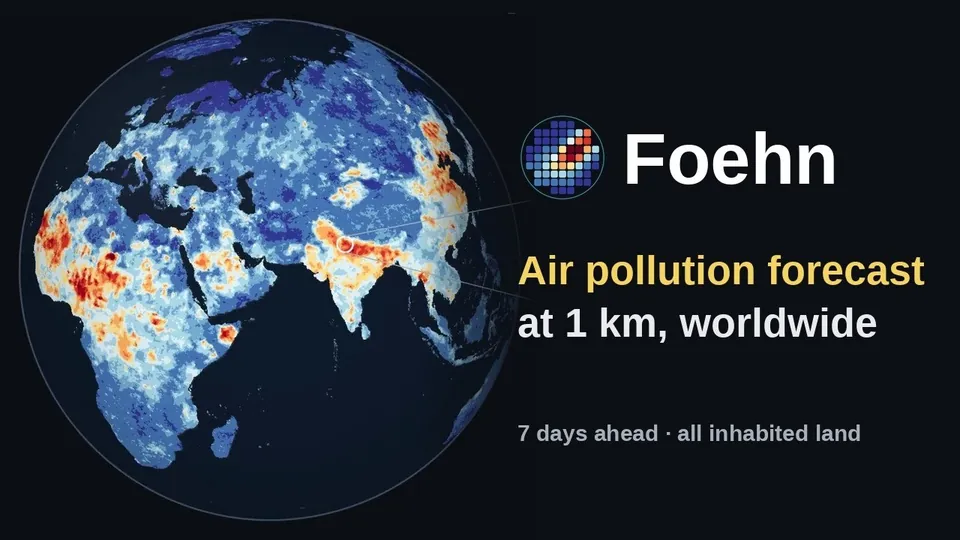
Short-term exposure to fine particles accounts for about a million deaths a year, yet operational forecasts run on grids tens of kilometres wide, which hide the pollution breathed by nearly two hundred million people a day. Foehn, the model we present in this preprint, forecasts PM2.5 at 1 km over all inhabited land, up to a week ahead.
7:46
From the particles you breathe to a forecast at 1 km, everywhere on Earth: the air traced backwards, the generator, the results.
 Playlist · 12 episodes + full film
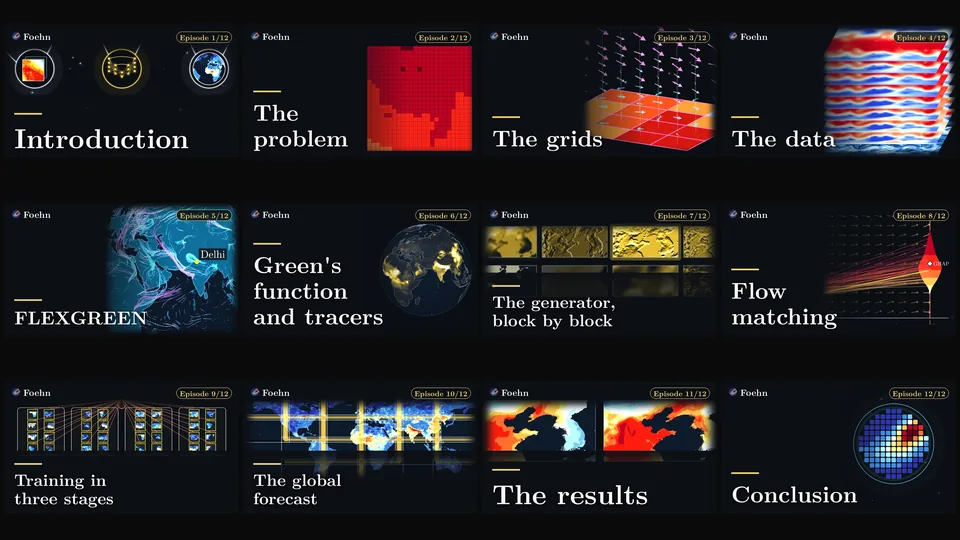
12 animated episodes and a 44-minute film explain Foehn block by block, from the problem and the data to FLEXGREEN, the generator and the results.
One line of work: from sparse stations (AQ-Net, 2025) to physics-guided transformers (TopoFlow, 2026), 1 km over Europe (CRAN-PM, 2026) and the whole planet (Foehn, 2026).
SCIA 2025 · Springer LNCS
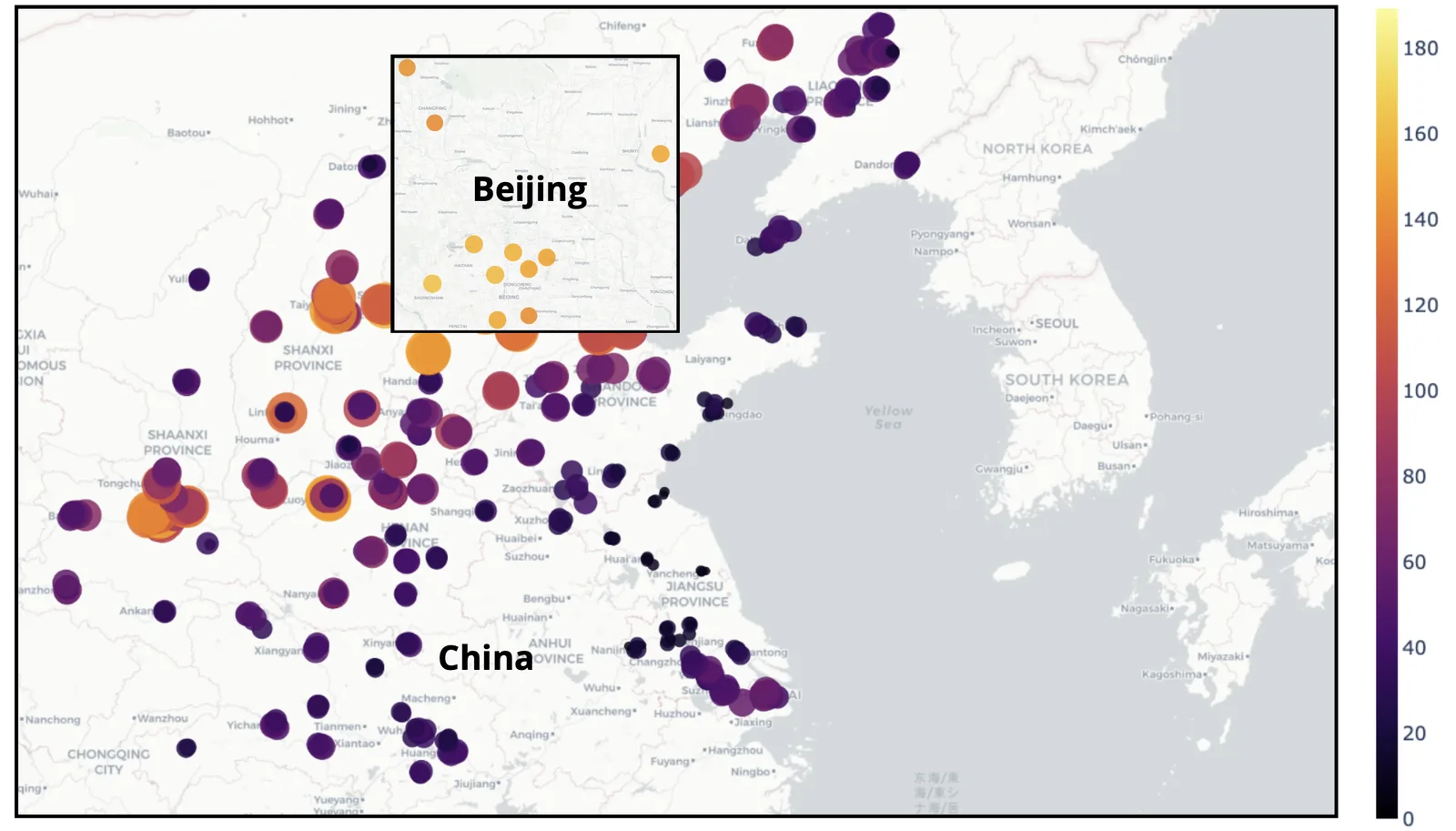
Air-quality reanalysis for stations with and without sensors: LSTM with attention and a neural kNN (northern China).
Read the case study →

npj Clim. Atmos. Sci. · 2026
A terrain- and wind-aware Vision Transformer: PM2.5 RMSE of 9.71 µg/m³ over China, a 71–80 % improvement over operational forecasting systems.
Read the case study →

arXiv preprint · 2026
A cross-resolution Vision Transformer that produces the 29-million-pixel European map at 1 km in 1.8 s on one GPU.
Read the case study →
Global probabilistic forecasting of air pollution
Preprint arXiv:2610.25941, 2026. Lead author
Global 1 km forecasts of PM2.5 up to a week ahead; more accurate than the operational forecast at three stations in four (retrospective, 2022).
@misc{kheder2026foehn,
  title         = {Global probabilistic forecasting of air pollution},
  author        = {Kheder, Ammar and Boy, Michael and Liu, Zhi-Song},
  year          = {2026},
  eprint        = {2610.25941},
  archivePrefix = {arXiv},
  primaryClass  = {cs.AI},
  url           = {https://arxiv.org/abs/2610.25941}
}
TopoFlow: topography-aware pollutant Flow learning for high-resolution air quality prediction
Journal npj Climate and Atmospheric Science 9, 143, Nature Portfolio, 2026. Lead author
Terrain- and wind-aware Vision Transformer; PM2.5 RMSE 9.71 µg/m³ over China, a 71–80 % improvement over operational forecasting systems.
@article{kheder2026topoflow,
  title   = {TopoFlow: topography-aware pollutant flow learning for high-resolution air quality prediction},
  author  = {Kheder, Ammar and Toropainen, Helmi and Peng, Wenqing and Ant{\~a}o, Samuel and Chen, Jia and Boy, Michael and Liu, Zhi-Song},
  journal = {npj Climate and Atmospheric Science},
  volume  = {9},
  number  = {1},
  pages   = {143},
  year    = {2026},
  doi     = {10.1038/s41612-026-01417-5}
}
Climate downscaling with likelihood functional flow matching
Preprint arXiv:2610.33482, 2026.
CD-FFM represents climate fields as continuous functions, queried at any resolution; ERA5 temperature downscaled to 1 km over Fennoscandia.
Nowcasting aerosol particle size distributions from PM2.5 with physics-regularized flow matching
Preprint arXiv:2610.33557, 2026.
Hourly particle size distributions estimated from routine PM2.5 and meteorology; a physics constraint lowers the error.
An actively trained neural operator for near-explicit atmospheric chemistry
Preprint arXiv:2610.33771, 2026.
A Fourier neural operator with a mixture of experts emulates a detailed chemistry mechanism, far faster than the numerical solver.
CRAN-PM: Cross-Resolution Attention Network for High-Resolution PM2.5 Prediction
Preprint arXiv:2603.11725, 2026. Lead author
Cross-resolution Vision Transformer: the 29-million-pixel European map at 1 km in 1.8 s on one GPU.
@misc{kheder2026cranpm,
  title         = {CRAN-PM: Cross-Resolution Attention Network for High-Resolution PM2.5 Prediction},
  author        = {Kheder, Ammar and Toropainen, Helmi and Peng, Wenqing and Ant{\~a}o, Samuel and Liu, Zhi-Song and Boy, Michael},
  year          = {2026},
  eprint        = {2603.11725},
  archivePrefix = {arXiv},
  url           = {https://arxiv.org/abs/2603.11725}
}
Inverse Neural Operator for ODE Parameter Optimization
Preprint arXiv:2603.11854, 2026.
Recovers hidden ODE parameters from sparse observations, 487× faster than iterative gradient descent.
Deep Spatio-Temporal Neural Network for Air Quality Reanalysis
Conference Scandinavian Conference on Image Analysis (SCIA), Springer LNCS, 2025. Lead author
Reanalysis of PM2.5 at stations with and without sensors, using a neural kNN (northern China).
@inproceedings{kheder2025aqnet,
  title     = {Deep Spatio-Temporal Neural Network for Air Quality Reanalysis},
  author    = {Kheder, Ammar and Foreback, Benjamin and Wang, Lili and Liu, Zhi-Song and Boy, Michael},
  booktitle = {Scandinavian Conference on Image Analysis (SCIA)},
  series    = {Lecture Notes in Computer Science},
  publisher = {Springer},
  year      = {2025},
  doi       = {10.1007/978-3-031-95911-0_6}
}