Short-term exposure to fine particulate matter (PM2.5) accounts for about a million deaths a year. Operational forecasts run on grids tens of kilometres wide, which hide the pollution breathed by nearly two hundred million people a day. Foehn is a generative model that learns from global kilometre-scale estimates of PM2.5 and computes where the air comes from: it forecasts daily PM2.5 at 1 km over all inhabited land, up to a week ahead, as a calibrated ensemble.
Two ideas carry it. FLEXGREEN follows the air backwards through the three-dimensional weather forecast and turns the origins of the air into transport maps, with no learned parameter. A flow-matching network then forecasts continent-sized windows in one pass, with no tile seams, drawing possible futures instead of their blurred average.
Over a year of retrospective forecasts (2022), at thousands of stations never used to train or select the model, Foehn was more accurate than the operational forecast issued at the same time at three stations in four, and its ensemble mean detected local pollution extremes four days ahead as well as the operational forecast did one day ahead. I led the method, the experiments and the writing; the preprint is on arXiv (2610.25941), with Michael Boy and Zhi-Song Liu.
1 km
Resolution
all inhabited land
7 days
Ahead
calibrated ensembles
3 in 4
Stations
beating the operational forecast
LUMI
Trained on
AMD MI250X GPUs
Key ideas
- Compute what physics knows. FLEXGREEN releases particles of air over every place on land and runs the weather forecast backwards, step by step, to find where that air was: a Green's function of the transport, computed once a day, with no learned parameter.
- Learn the rest. A generative network trained by flow matching turns noise into a kilometre-scale forecast, conditioned on the start day, the weather and the transport maps, over continent-sized windows in a single pass.
- Possible futures, not their average. Sixty-four members form an ensemble whose spread is calibrated, so the peaks that matter for health are forecast instead of smoothed away.
- Validated where it was never trained. A year of forecasts (2022) scored at thousands of official and OpenAQ stations, against the operational forecast issued at the same time, including the extremes and the people whom coarse grids hide.
The film
Eight minutes, from the particles you breathe to the forecast: the people whom coarse grids hide, the air followed backwards through the weather forecast, the generator that turns noise into a forecast, and how well it works at thousands of stations.
Visualisations
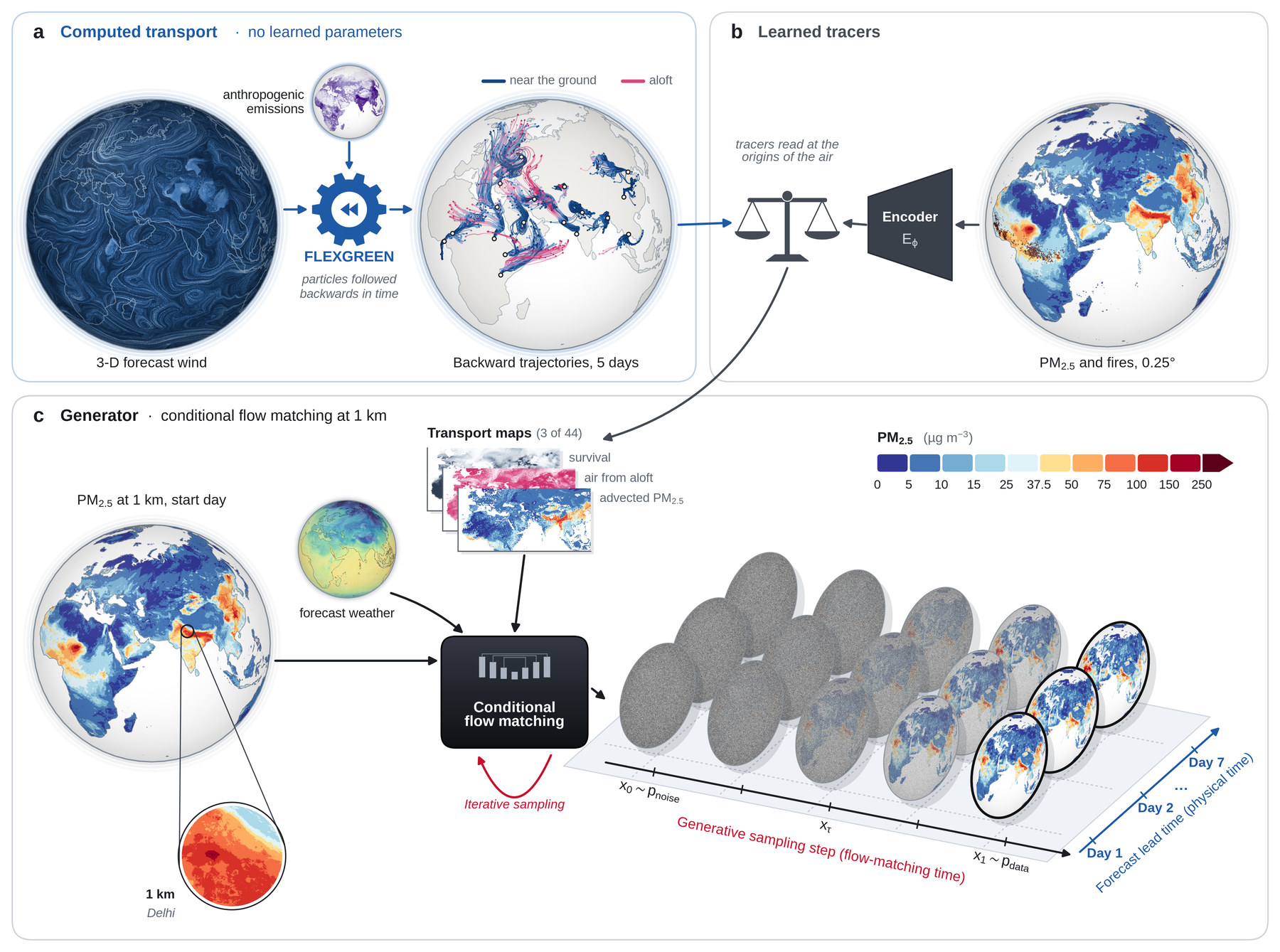 Architecture: computed transport, learned tracers, the generator
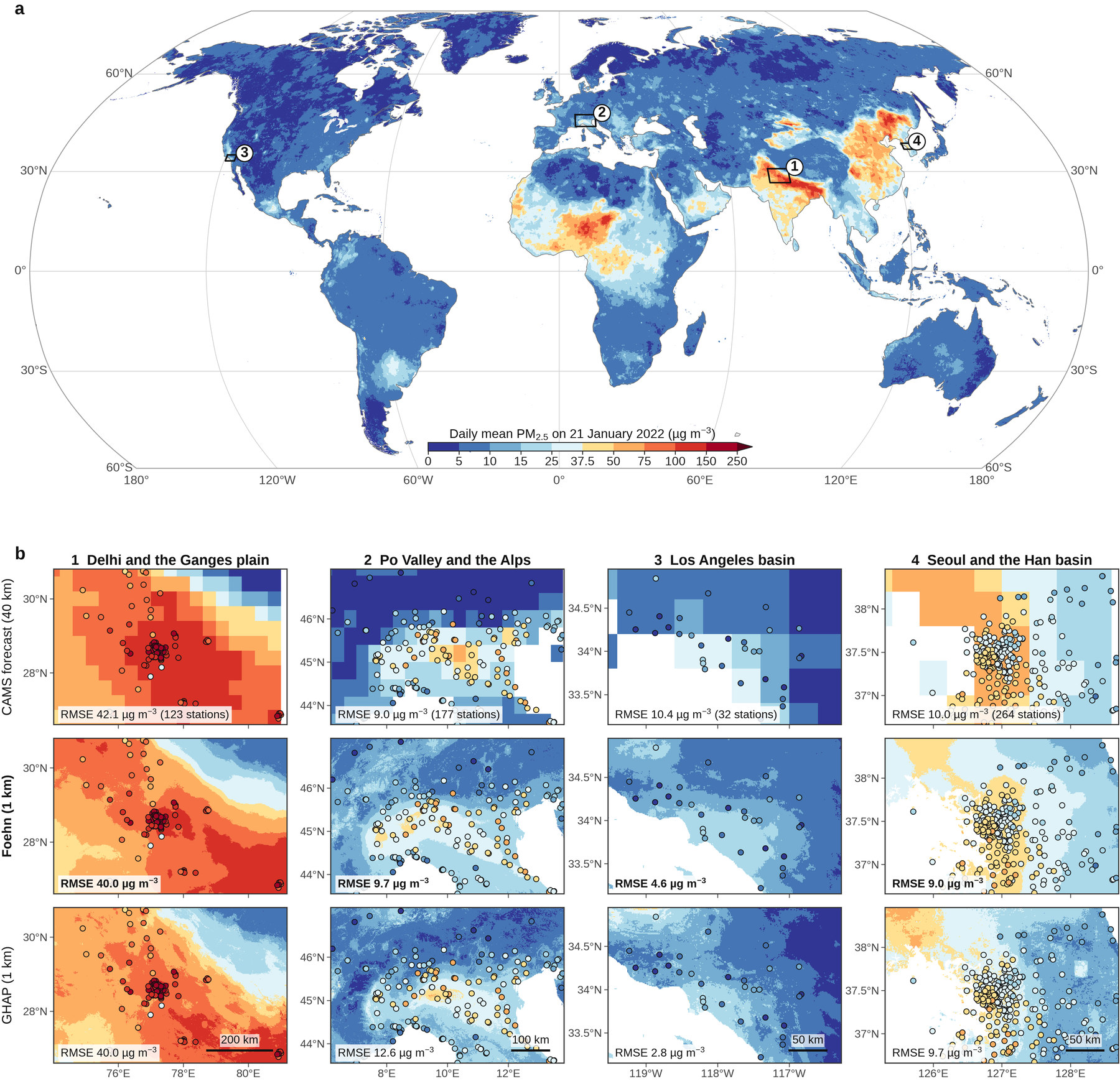 Four polluted basins against the operational forecast and the 1 km estimates
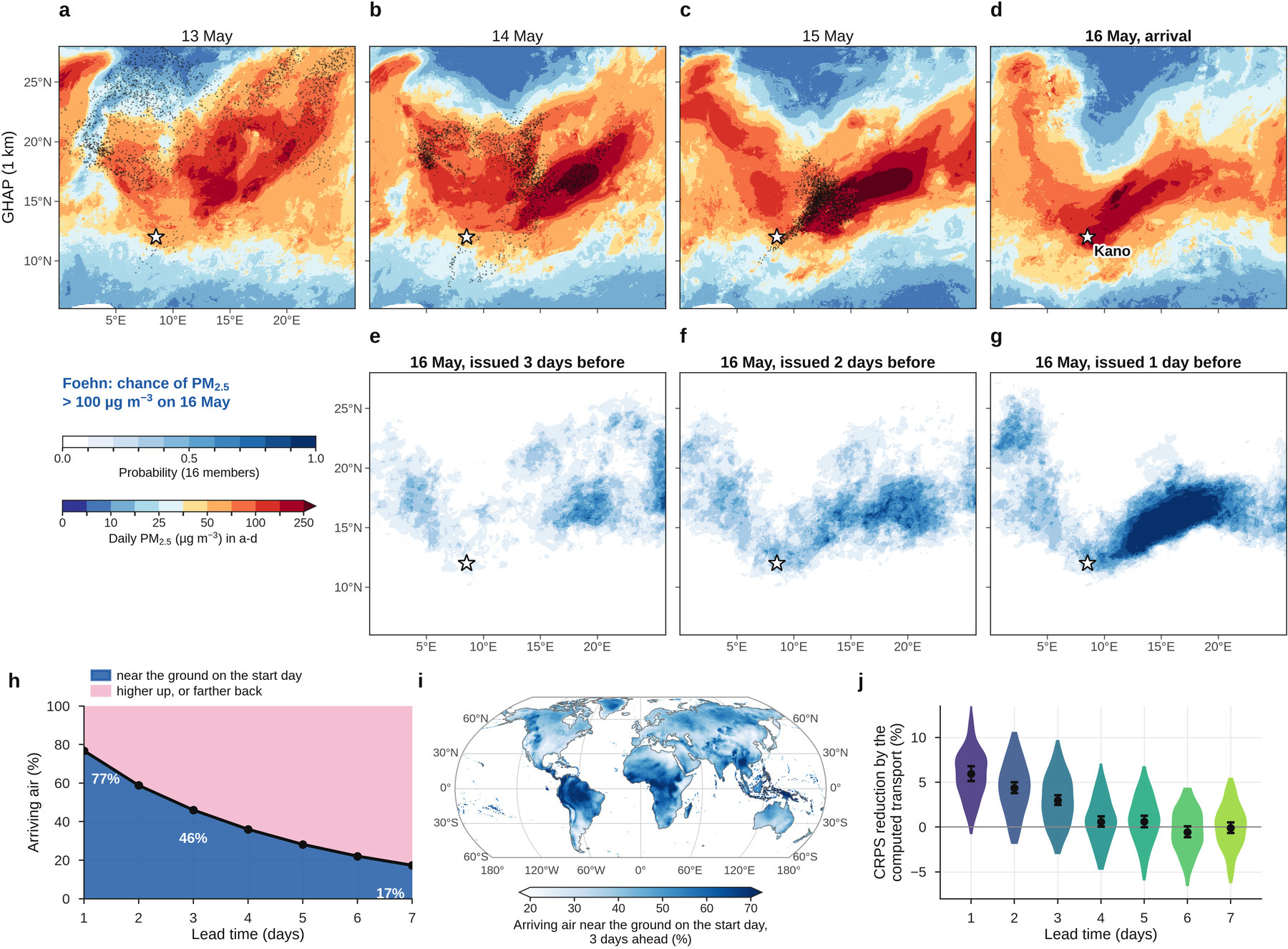 Where the air reaching Kano was on the three preceding days
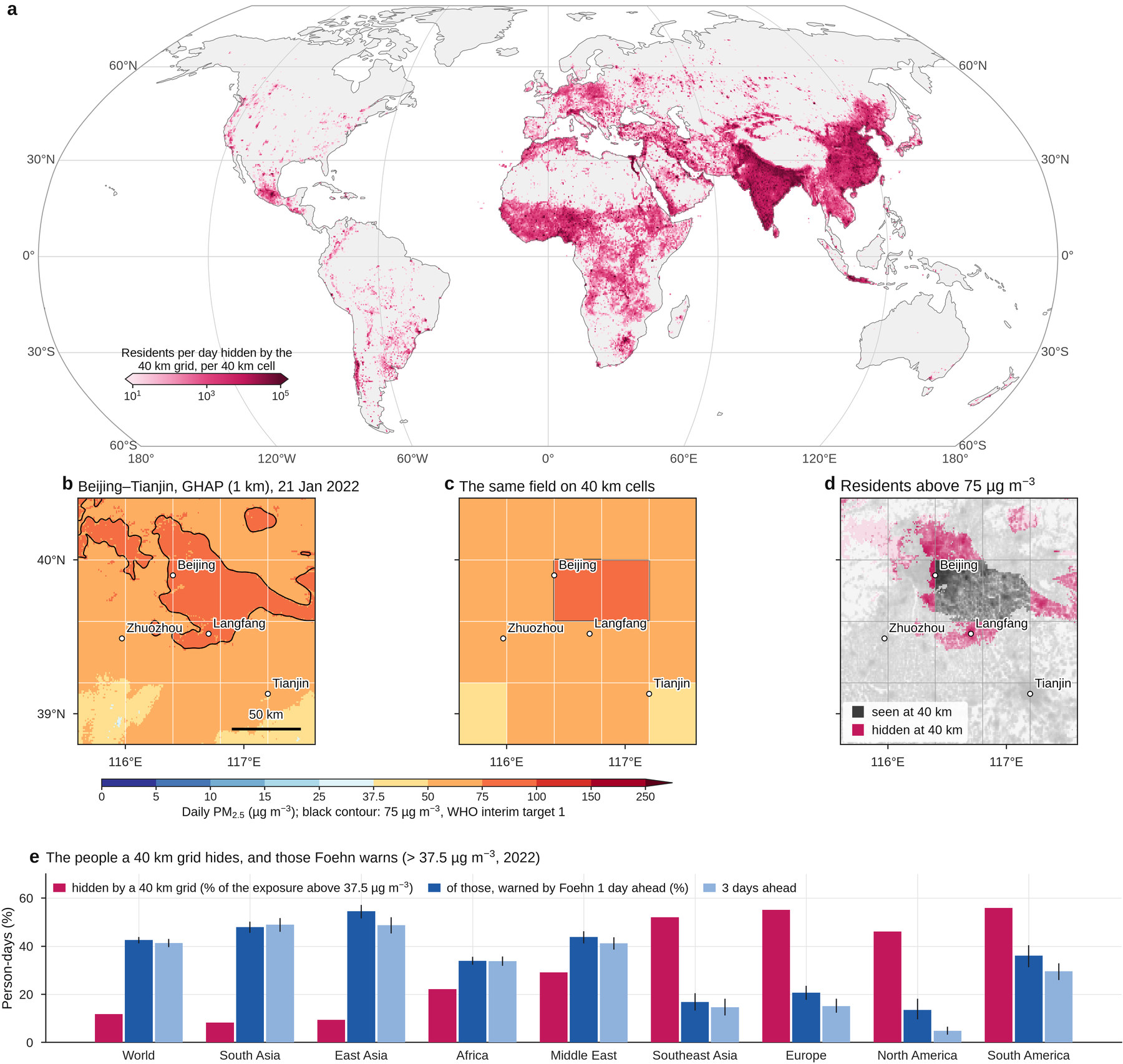 The residents a 40 km forecast cannot warn
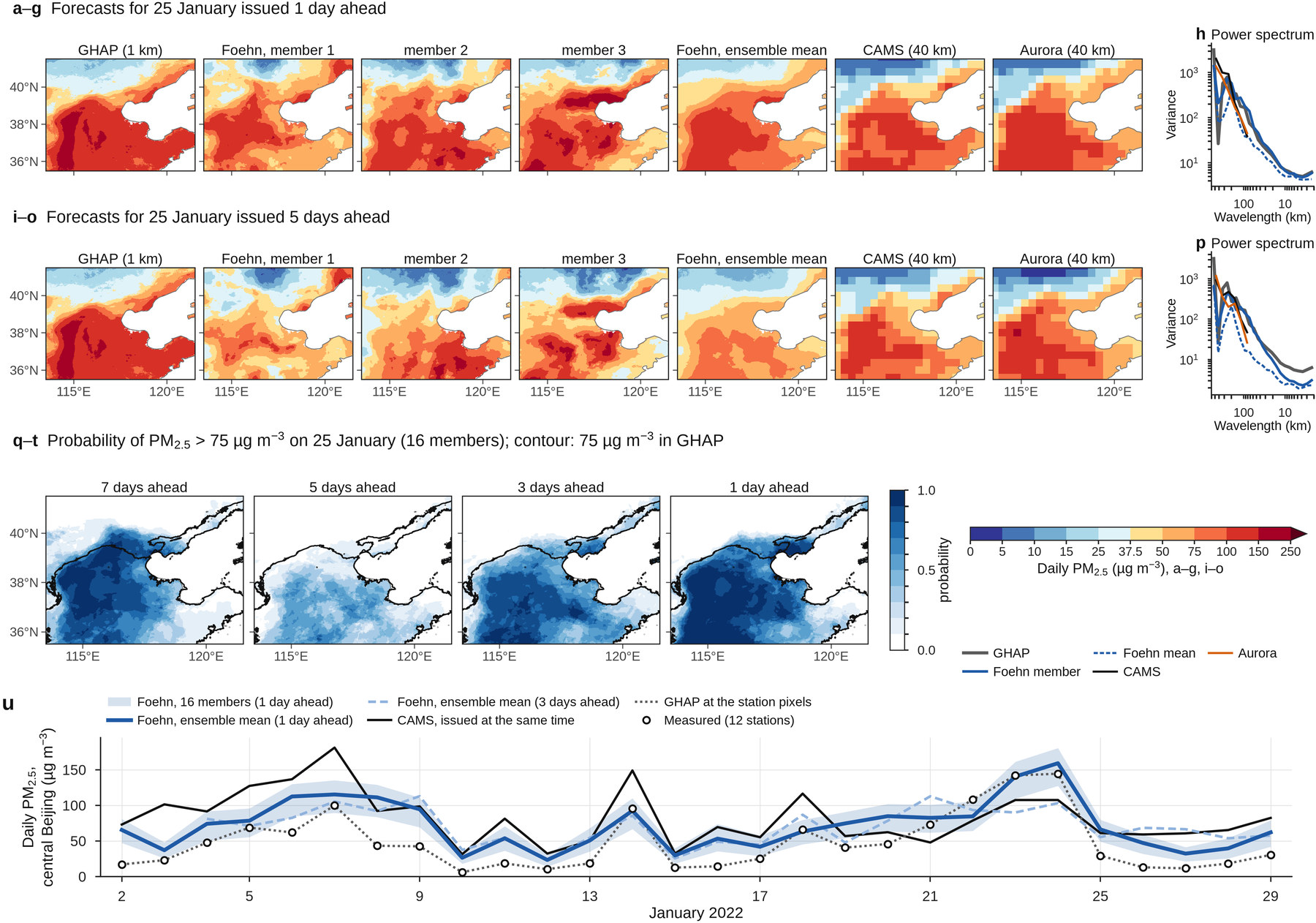 The January 2022 haze over Beijing, one and five days ahead
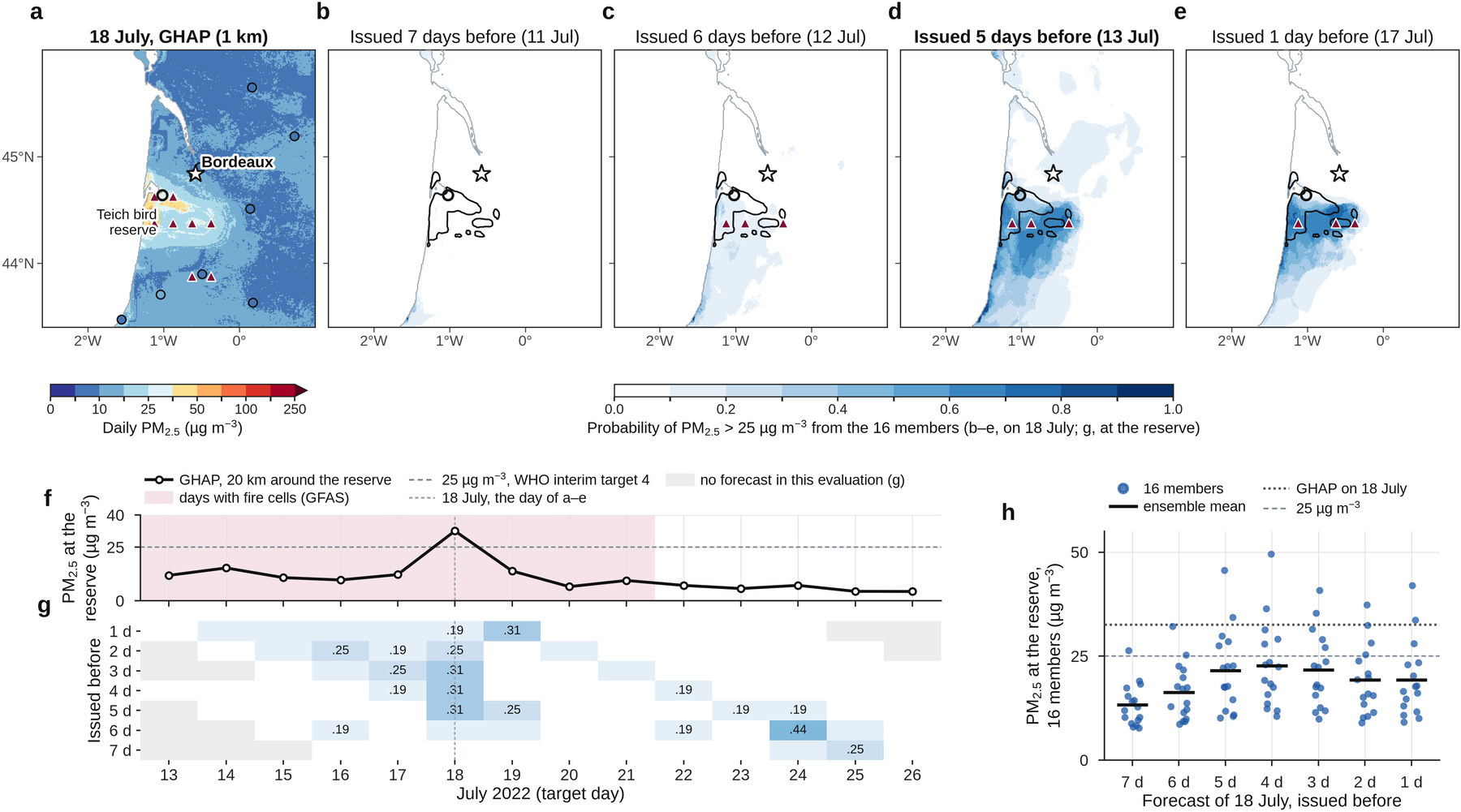 The smoke of 18 July 2022, forecast one to seven days before
Resources
arXiv preprint Project website & interactive forecasts The film (8 min) Code on GitHub
Credits
- Authors
- A. Kheder, M. Boy, Z.-S. Liu
- Venue
- arXiv preprint 2610.25941, 2026
- Compute
- LUMI supercomputer (AMD MI250X GPUs), CSC Finland
- Affiliation
- INAR, University of Helsinki · LUT University · Atmospheric Modelling Centre (AMC-Lahti)